How to Remove Tonsil Stones Without Hurting Your Throat
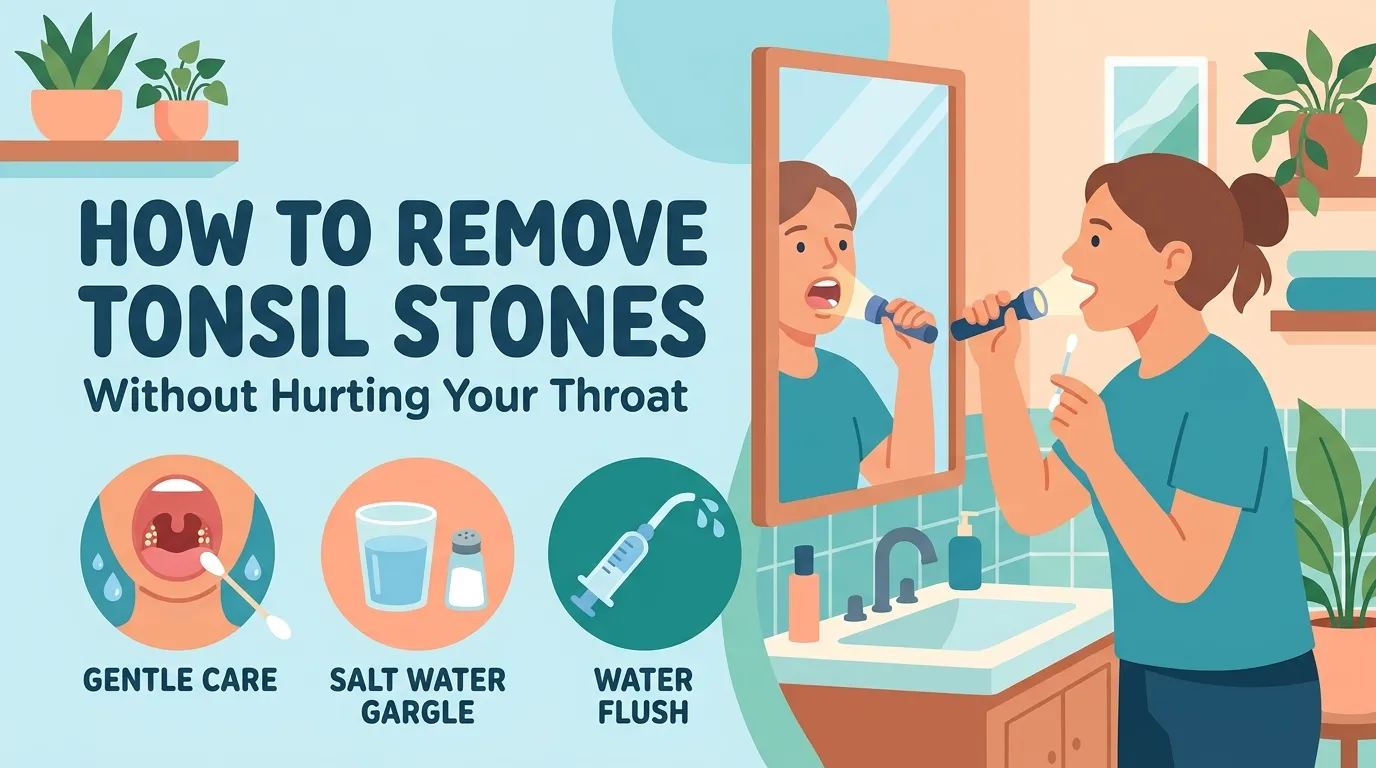
To remove tonsil stones at home, start with gentle warm saltwater gargling and regular oral hygiene. Small stones often come out on their own. If a stone remains stuck, cannot be seen or triggers gagging, avoid digging or forcing it out. A clinician can confirm what it is and whether removal is needed.
First, make sure you are dealing with a stone. White patches, significant pain or swelling can have other causes.
Get emergency care for trouble breathing, inability to swallow saliva, rapidly worsening throat swelling or difficulty speaking or opening your mouth. In the US, call 911 for a medical emergency.
This guide provides general information, not a diagnosis. Read Oxpoll’s disclaimer for the website’s information limitations.
How to remove tonsil stones at home: start gently
A tonsil stone, also called a tonsillolith, forms when trapped material hardens in a pocket of tonsil tissue. If a small stone is not bothering you, leaving it alone is often reasonable.
The American Family Physician’s 2023 clinical review describes observation as the usual approach, with surgery rarely necessary. “Observation” means allowing an uncomplicated stone to clear rather than immediately performing a procedure.
For an adult who can gargle comfortably, these are sensible first steps:
| Step | What to do | Limit |
|---|---|---|
| Gargle gently | Mix half a teaspoon of salt into a glass of comfortably warm water. Gargle and spit it out. | Do not swallow it or force yourself to gargle through choking or gagging. |
| Clean your mouth | Brush your teeth and tongue gently, and clean between your teeth. | Do not extend the toothbrush onto your tonsils. |
| Stay hydrated | Drink water regularly. | Water does not guarantee that an existing stone will come out. |
| Give it time | A small stone may loosen during normal activity or coughing. | Persistent symptoms need assessment rather than increasingly forceful attempts. |
The saltwater preparation follows NHS guidance. Young children should not gargle with saltwater, and nobody should attempt it if they cannot reliably gargle and spit.
Learning how to remove tonsil stones safely includes knowing when another attempt is unlikely to help.
Are those white things on your tonsils actually stones?
A discrete white or yellow lump can be a tonsil stone. However, color alone does not establish the diagnosis.
| Finding | Possible explanation | Next step |
|---|---|---|
| Small white or yellow lump in a tonsil pocket | Tonsil stone | Gentle care may be reasonable if symptoms are mild. |
| Red, swollen tonsils with white patches, fever or significant soreness | Tonsillitis or another infection | Seek medical assessment rather than scraping. |
| White patches elsewhere in the mouth, sometimes with redness or soreness | Oral thrush or another condition | Get the cause checked. |
| Persistent unexplained patch, lump or one-sided change | Several possibilities | Arrange an examination. |
Tonsillitis can produce white pus-filled spots, and oral thrush can produce white patches. Neither should be treated as material to dig out.
Where are tonsil stones located?
They usually form in tonsillar crypts, the small folds and pockets in the palatine tonsils on either side of the back of your throat.
Some sit near the surface; others are concealed within those pockets. The sensation of something being stuck does not tell you its exact location.
“Mouth stones” is an imprecise phrase. Salivary gland stones affect the glands or ducts carrying saliva, making them a different problem from tonsil stones. A lump under the tongue or swelling associated with meals deserves assessment rather than tonsil-removal techniques.
How to remove tonsil stones without gagging
Choose an approach that avoids touching the tonsil, rather than trying to overcome your gag reflex.
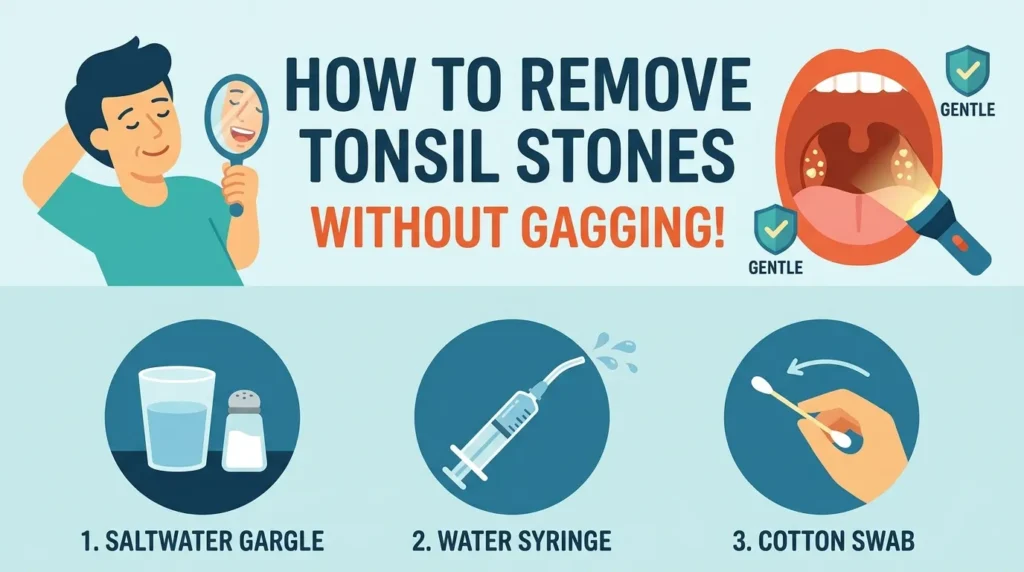
If gentle gargling is comfortable, it may help a small stone loosen. If gargling itself makes you gag, stop. Continue ordinary oral care and discuss persistent symptoms with a clinician.
There is no technique that guarantees gag-free removal for everyone. Do not keep reaching farther back, repeatedly trigger vomiting or use numbing products simply to tolerate probing.
For example, suppose a visible stone is painless, but every attempt to touch it causes gagging. The useful next step is not a longer tool. It is to leave it alone and ask whether removal is necessary.
A clinician can examine the area and discuss options suited to your anatomy and symptoms.
How to remove tonsil stones you can’t see
Do not probe blindly for hidden tonsil stones. A suspected stone is not a confirmed stone.
Bad breath, an unpleasant taste or a throat sensation can occur with stones, but those symptoms have other causes. Repeatedly pressing around the tonsil to “find” something can injure tissue without resolving the actual problem.
You can continue gentle oral care while arranging an examination if symptoms persist. A clinician may identify a concealed stone during assessment; scans are not automatically necessary.
Also consider where the discomfort starts. Tooth pain, gum swelling or pus around a tooth needs dental assessment. Our guide to dental infection warning signs explains that separate problem; an uncomplicated tonsil stone is not the same as a dental abscess.
Should you push out or dislodge a tonsil stone?
Online instructions often recommend cotton swabs or water flossers. Medical guidance differs on these methods.
Cleveland Clinic includes gentle swab removal and water picks among possible home approaches. Northwestern Medicine advises against scraping with a finger, cotton swab or tool. NHS Devon warns that manual removal and water-jet irrigation can cause injury, bleeding, infection or inhalation of a foreign body.
Because a general article cannot assess your tonsils or control the pressure you apply, this guide recommends gargling and noninvasive care before considering clinician-guided removal.
If you searched “how to push out tonsil stones” or “how to dislodge tonsil stones,” the distinction is pressure versus gentle loosening. A stone that does not loosen is not an invitation to press harder.
Avoid:
- Fingernails, tweezers, toothpicks or metal extraction tools.
- Scraping, cutting or puncturing tonsil tissue.
- Aiming a forceful water jet into the tonsil.
- Continuing after pain, bleeding or gagging starts.
For questions about how to take out tonsil stones with a device, ask a clinician whether that approach is appropriate for you before using it.
Can you dissolve tonsil stones?
There is no dependable home treatment established here that chemically dissolves a tonsil stone.
Saltwater may help loosen material or soothe the throat. That is different from dissolving a hardened deposit.
Do not assume that vinegar, lemon juice or a concentrated rinse is effective because it is described as a “natural solvent.” This review did not establish a reliable benefit from those approaches, and irritating mixtures are a poor choice for delicate throat tissue.
Antibiotics are not stone-dissolving medicines. A clinician may prescribe them for a diagnosed bacterial infection, which is a separate treatment decision.
If a product claims to dissolve every stone or prevent recurrence permanently, look for clinical evidence supporting that specific claim.
Tonsil stone stuck? Know when to stop
A stone can remain in a crypt even when it looks close to coming out. Repeated attempts may leave you with more discomfort than the stone originally caused.
| Situation | Appropriate next step |
|---|---|
| Small stone, no meaningful symptoms | Leave it alone or use gentle gargling if comfortable. |
| Persistent discomfort, recurring stones or ongoing bad breath | Arrange a medical or dental assessment. |
| Pain or bleeding after an attempt | Stop manipulating the area; seek advice, urgently if bleeding continues or is substantial. |
| Fever, worsening one-sided pain or painful swelling | Get prompt medical assessment. |
| Breathing difficulty, inability to swallow saliva or severe rapidly worsening symptoms | Seek emergency care. |
Do not promise yourself “one last push.” If gentle care has failed, change the plan rather than increase the force.
Are tonsil stones dangerous or contagious?
Tonsil stones themselves are not contagious and are usually harmless. You cannot pass a stone to someone else.
However, an infection causing sore throat and white patches may be contagious. A stone and an infection can also coexist, so the presence of a visible stone does not explain every symptom.
When symptoms point beyond a routine stone
A peritonsillar abscess, also called quinsy, is a collection of pus near a tonsil. It is different from a tonsil stone and requires medical treatment.
Severe throat pain that worsens quickly, swelling, difficulty speaking, inability to swallow, breathing difficulty or difficulty opening the mouth can signal this complication. Seek emergency assessment rather than attempting removal.
Does everyone have tonsil stones?
No. They are common, but having tonsils does not mean everyone develops noticeable stones.
Some people have small stones without realizing it. Others experience repeated buildup, particularly when the tonsils have pockets that trap material.
Stones are not proof that someone neglects oral hygiene. Anatomy and a history of tonsil inflammation can contribute, although cleaning the teeth, tongue and mouth remains useful.
To reduce buildup:
- Brush and clean between your teeth regularly.
- Clean your tongue gently.
- Stay hydrated.
- Discuss persistent nasal drainage, throat symptoms or recurrent infections with a clinician.
These habits may reduce risk; they cannot guarantee permanent prevention.
What can a clinician do when home care is not enough?
An examination comes first. A clinician needs to establish whether the problem is a stone, infection or another cause of symptoms.
For a troublesome stone, removal during an office visit may be possible. Persistent or recurrent problems may justify assessment by an ear, nose and throat specialist, or ENT.
Tonsillectomy is not an automatic next step. Removing the tonsils is surgery with recovery demands and bleeding risks. Recommendations and access vary: Cleveland Clinic describes surgery as an option in selected circumstances, while NHS Devon does not recommend routine tonsillectomy for stones alone.
Procedures intended to reduce tonsillar pockets, such as laser or coblation cryptolysis, also have evidence limitations. Discuss their benefits, risks and alternatives rather than assuming they offer a simple cure.
Questions about how to remove tonsil stones
How do you get out tonsil stones that keep returning?
Repeated removal does not eliminate the pockets where material collects. Maintain oral care and arrange an assessment if recurrence causes ongoing discomfort or bad breath.
Can a tonsil stone come out on its own?
Yes. Small stones often loosen without a procedure, and an asymptomatic stone may need no treatment.
What happens if you swallow a tonsil stone?
Swallowing a small stone is generally harmless. Breathing difficulty or choking is a different situation and needs immediate help.
Can a dentist help?
A dentist can assess oral causes of bad breath or discomfort and advise whether you need medical or ENT assessment. Not every practice performs tonsil-stone removal.
The practical approach to how to remove tonsil stones is gentle care first, no blind probing and professional assessment when symptoms persist. A stone that refuses to move does not need a more forceful attempt.